
The Complete Guide to Cone Crushers
Learn how cone crushers work, their key components, and how to choose the right crushing setup for your aggregate site.
Key Takeaways
- Primary Function: Provides secondary and tertiary crushing by using a continuous compressive mantle-and-concave motion to fracture tough, abrasive rock into smaller, uniform aggregates.
- How It Works: Material enters the crushing chamber and is squeezed between a stationary outer bowl (concave) and an eccentric moving inner cone (mantle).
- Key Adjustments: Output size is dictated by the Closed Side Setting (CSS), a smaller setting creates finer product, while a larger setting yields coarser material.
- Primary Advantage: Delivers high reduction ratios (typically up to 4:1) with high efficiency and excellent cubical product shape.
What are cone crushers?
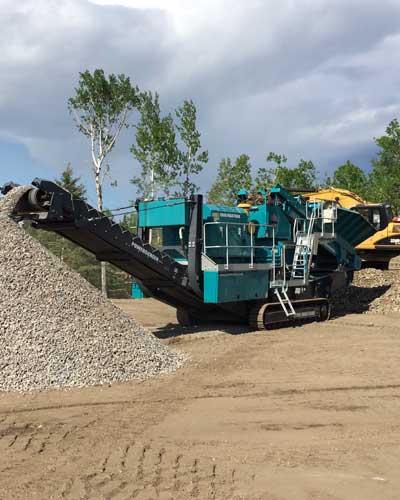
Cone crushers are used to take hard rock and other tough materials that have already been crushed once and reduce them even further.They are most often used after a jaw crusher or another primary crusher has done the first stage of the work.
A cone crusher uses compression to break the material down. Think of it as a moving cone inside a fixed bowl. The rock gets caught between the two surfaces and squeezed until it breaks.
Cone crushers are commonly used in aggregate production because they can produce a smaller, more consistent and more evenly shaped finished product.
Depending on the application and crusher setup, they can also achieve fairly high reduction ratios. A 4:1 reduction ratio, for example, means material can be reduced to roughly one-quarter of its original size.
How cone crushers work.
How Does The Crushing Chamber Of A Cone Crusher Work?
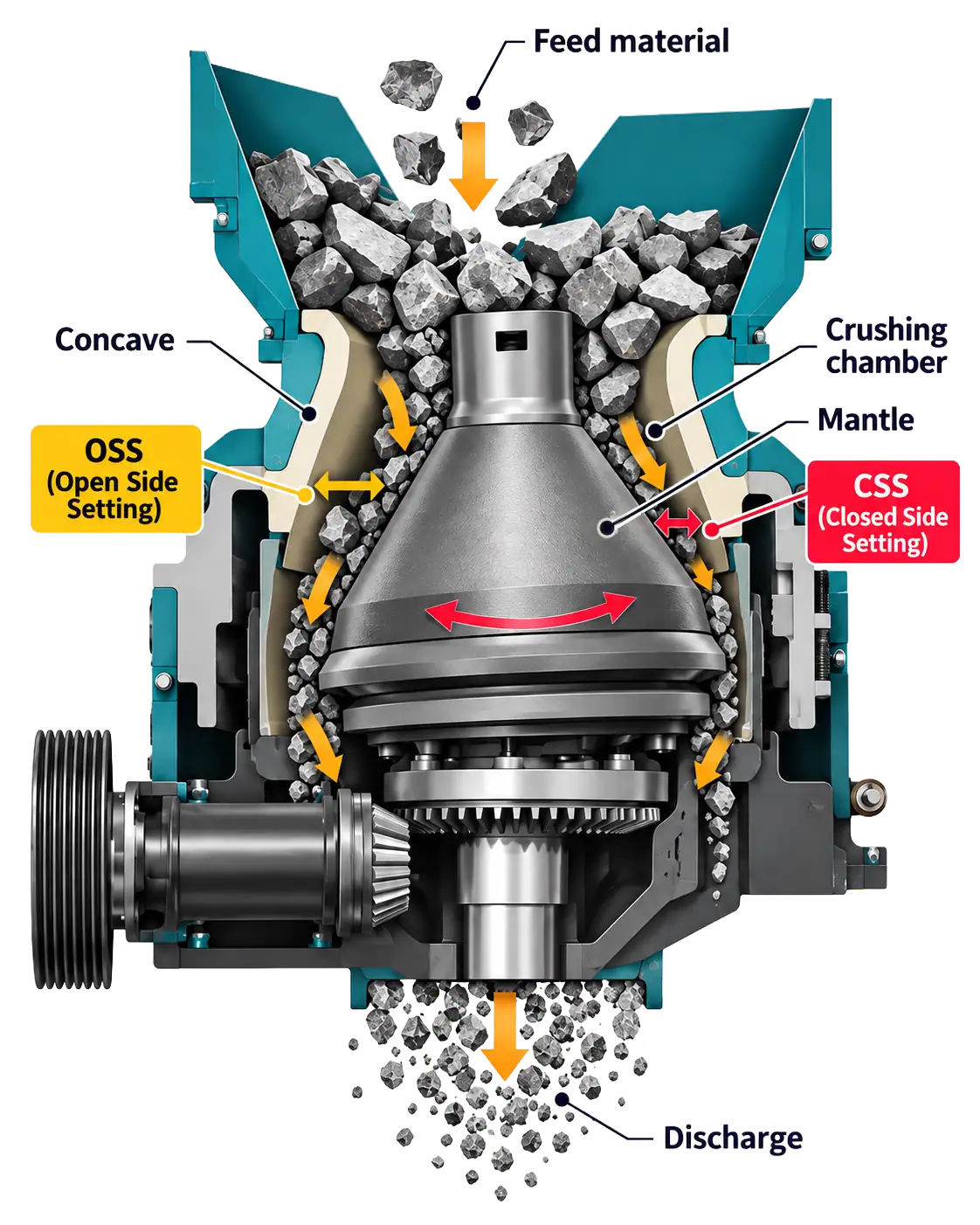
Inside the crushing chamber of cone crushers is two main crushing surfaces: a stationary outer liner called the concave and a moving inner liner called the mantle.
The mantle is continuously moving in a slightly off-centre (elliptical) motion. As it moves, the space between the mantle and concave constantly opens and closes. The changing gap is what does the crushing. When the gap gets smaller, the material is squeezed between the two surfaces with enough force to fracture and break. As the mantle moves away again, the broken material drops further down into the crushing chamber where it is then caught and crushed again.
The process continues until all of the material has passed through the bottom of the crusher.
Open and Closed Side Settings
The smallest distance between the the mantle and concave is called the closed side setting (CSS). CSS is one of the main adjustments used to control the size of the finished product. A smaller CSS produces finer material. A larger setting allows larger material to pass through the crusher.
The widest distance between the mantle and concave is called open side setting, or OSS.
Frequently Asked Questions About Cone Crushers
What’s the difference between a jaw crusher and a cone crusher?
Think of a jaw crusher as the heavy lifter for the first round of work (primary crushing). It takes giant, freshly blasted boulders and smashes them down into manageable pieces using a heavy swinging jaw plate.
A cone crusher steps in for the second or third stage (secondary or tertiary crushing). It takes those smaller rocks and continuously squeezes them down into precise, neatly shaped gravel or stone products.
What do CSS and OSS mean, and why do they matter?
These settings control the size of the rock coming out of your machine:
CSS (Closed Side Setting): This is the tightest gap between the moving inner cone and the outer shell during a rotation. It sets the size of your final finished product—the smaller the gap, the finer the rock.
OSS (Open Side Setting): This is the widest point of the gap during rotation. It determines the largest size of rock that can feed into the chamber without jamming it up.
What is "tramp iron release," and why is it important?
Every now and then, uncrushable metal pieces—like broken excavator teeth, rebar, or stray bolts—accidental feed into the crusher. If crushed, these can cause massive structural damage.
Tramp iron release is an automatic safety feature (usually powered by hydraulics or heavy springs) that instantly opens up the crushing chamber to let the piece of metal fall safely through, then resets the machine back to its normal setting without stopping work.
How much smaller will a cone crusher make the rock?
Most modern cone crushers operate at a 3:1 or 4:1 reduction ratio. In simple terms: if you feed an 8-inch rock into a crusher set at a 4:1 ratio, it will come out as 2-inch finished stone.
How do I know which liner (coarse, medium, or fine) I need?
The “liner” is the replaceable wear surface inside the crusher. Which one you need depends on the job:
Coarse Liners: Have a wide opening at the top to take in bigger rocks (great for secondary crushing).
Medium & Fine Liners: Have a narrower opening built for smaller feed sizes, perfect when you need to make fine gravel, sand, or concrete aggregates (tertiary crushing)